
EV Workshop blog
Useful articles on electric car repair and maintenance — based on our workshop's experience in Riga.
- 4.7 · 56 Google reviews
- Since 2021
- 3000+ cars serviced
- Warranty on work
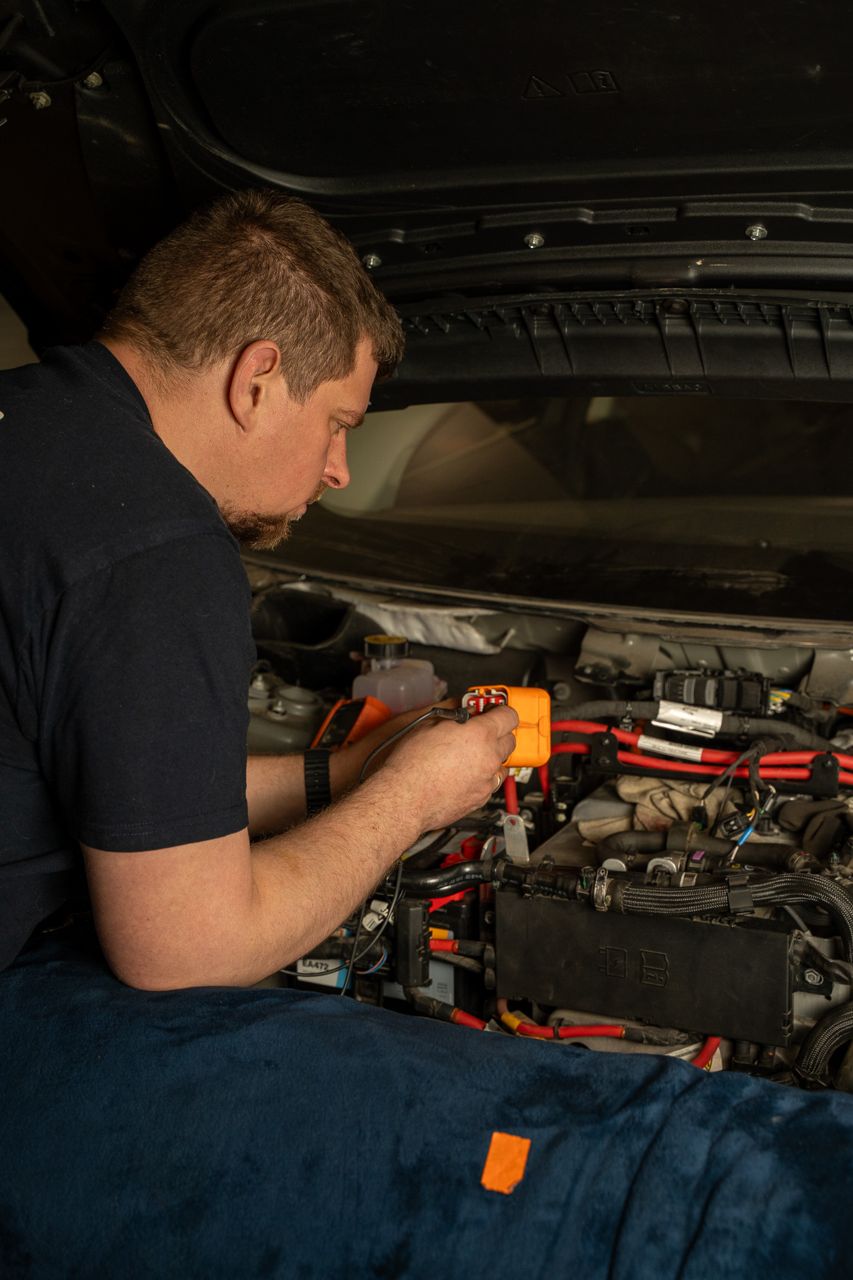
What to check before buying a used EVReadBattery, error codes, body and paint, suspension and interior — what we check before the deal and why. Inspection €120, 3–4 hours.
A used electric car can look perfect, while the most expensive problems hide in the battery, the high-voltage system and the body after a repair. Here is what we at EV Workshop check before the deal.
What the inspection covers
- Battery. An SOH test shows how much capacity the battery has kept and whether the cells are out of balance. A battery replacement is the most expensive EV repair, so this is the first thing to know.
- Error codes. With Tesla Toolbox and Autel Ultra EV we read the errors from all control units: high-voltage system, charging, safety systems.
- Body and paint. With a paint thickness gauge we measure the coating on every panel and see what has been repainted or filled. We inspect the body for signs of accident repair.
- Suspension. Control arms, bushings, ball joints, shock absorbers.
- Functions and interior. We check that the main functions and electronics work and inspect the interior.
How long it takes and what it costs
The inspection takes 3–4 hours and is carried out by several of our specialists. Price: €120 incl. VAT. Afterwards we explain what we found and how serious it is.
Tip
Agree with the seller in advance that the car will be brought to us for inspection. If the seller refuses, that is a reason to be careful.
FAQ
How much does a pre-purchase inspection cost?
€120 incl. VAT.
How long does the inspection take?
3–4 hours; several specialists carry it out.
Battery SOH test: what is critical and what is notReadHow much battery wear is normal, when cell imbalance is dangerous, repair or replace, and what Tesla replaces under warranty.
Buying a used EV, or has your range dropped? The first thing to check is the high-voltage battery. Here is how we at EV Workshop read SOH test results and what we see in practice.
What SOH is
SOH (State of Health) shows how much capacity the battery has kept compared with new. 100% means as new; 85% means the battery holds 85% of its original energy. It is not the charge level on the screen — it is wear.
With Autel Ultra EV we read SOH, cell and module voltages and high-voltage system faults. The test costs 50 € incl. VAT and includes a written report.
How much wear is normal
In our experience, losing up to 10% of capacity in the first 120,000 km is normal (the car's age matters too). After that the battery loses capacity more slowly. As a guide:
- 90–100% — good condition;
- 80–90% — noticeable wear, typical for older high-mileage cars;
- below 80% — heavy wear: range is noticeably shorter, and in practice BMS errors usually start to appear;
- below 70% — Tesla's warranty threshold (see below).
Cell imbalance: the key indicator
A battery is made of many cells grouped into modules. Ideally they all have the same voltage. The difference between the "strongest" and "weakest" cell is the imbalance — often more important than the SOH figure itself.
- up to 6–8 mV — normal;
- 8–20 mV — keep an eye on it and repeat the test;
- over 20 mV — bad: the car is likely to stop soon.
Under load the spread momentarily gets larger — that is exactly how weak cells show up, so a single measurement at rest is not enough.
Repair or replace the battery
If the chemistry in some cells has degraded or electrolyte has leaked, it is very likely to affect other parts of the battery over time. That is why repairing such a battery usually costs more in the medium term: a module replaced today, a problem in the next one later. It is simpler to replace the battery with a newer one and forget about the problem for a long time. More in "Tesla Model 3 / Y battery: repair or replace?".
Model S and Model X with 100 kWh packs: connections come loose
On 100 kWh packs (Model S and Model X, mostly 2018–2019) the thin connections the BMS uses to measure cell-group voltage often come loose. The modules expand with temperature, contact is lost, and BMS errors and imbalance appear. Some of these cars are still under warranty — then go to Tesla; others already need repair.
We don't restore just the individual failed contacts: if the problem has appeared in one place, it will soon appear in others. So we offer to restore all connections in all 16 modules — hundreds of points, but the problem is solved for a long time.
Not critical
- Up to 10% capacity loss in the first 120,000 km.
- Less range in winter — a cold battery and cabin heating, not wear.
- The range estimate on the screen "jumps" — the BMS sometimes needs calibrating.
- Cell spread up to 6–8 mV.
Critical — get a diagnosis
- Cell spread over 20 mV.
- A high-voltage isolation fault — dangerous, often caused by moisture.
- The battery loses charge noticeably while parked.
- BMS errors, reduced power, the car won't charge to 100% — see our article on BMS errors.
- Signs of impact, corrosion or moisture on the battery casing.
What Tesla replaces under warranty
Teslas have a Battery and Drive Unit warranty. For new cars in Europe:
- Model S and Model X — 8 years or 240,000 km;
- Model 3 and Model Y RWD — 8 years or 160,000 km;
- Model 3 and Model Y Long Range and Performance — 8 years or 192,000 km.
The condition is that the battery keeps at least 70% of its capacity during the warranty period. If capacity drops below that or the battery fails (module defect, isolation fault, BMS failure), Tesla repairs or replaces it, including with a remanufactured pack. The remaining warranty transfers to the next owner. Early Model 3s see many warranty battery replacements — always check how much warranty is left.
Model S and Model X bought before 29 January 2020 stay on the old terms: 8 years with unlimited mileage, but no capacity threshold — gradual capacity loss is generally not covered.
Tip: if the car is still under warranty and the test shows a problem, go to Tesla and have the battery replaced under warranty. Our written report will help with your claim.
If the warranty has expired
You can buy insurance for such cases: for example, Mango Insurance offers breakdown insurance packages for cars for up to 3 years. Before buying, check that the policy covers the high-voltage battery.
Before buying a used EV
Check SOH, cell imbalance and faults, plus the remaining warranty — based on first registration date and mileage. If you also need the body, geometry and suspension checked, a full pre-purchase inspection costs 120 €.
FAQ
How much does an SOH test cost?
50 € incl. VAT, with a written report.
What cell imbalance is normal?
Up to 6–8 mV is normal. Over 20 mV is bad: the car is likely to stop soon.
How much battery wear is normal?
In our experience, up to 10% in the first 120,000 km. For a Tesla under warranty, capacity falling below 70% is a warranty case.
EV not charging: 5 common causes and what to doReadWhy an EV or Tesla won't charge: onboard charger, high-voltage system, wiring, body ground points, battery imbalance. What to check yourself and when to visit a workshop.
Plugged in, but the car won't charge, keeps stopping or gets stuck at 50–80%? This is one of the most common reasons owners of Tesla, Hyundai Kona, Kia Niro, Audi e-tron, Nissan Leaf and other EVs come to EV Workshop. Here is what usually turns out to be the cause in our practice.
Rule out the simple things first
- Try a different charger or cable — the problem may be the charger, not the car.
- Check the charge limit and charging schedule in the settings.
- In winter a cold battery charges slowly, and DC fast charging is limited until the battery warms up — that is normal.
If it is the same at other chargers and an error shows on the screen, the problem is the car.
1. Failed onboard charger
The onboard charger (OBC; on Hyundai and Kia the ICCU unit) converts AC from a socket or home wallbox. When it fails, the car stops charging on AC, while DC fast charging may still work. This is one of the most frequent cases we see.
2. High-voltage system faults
If the system detects a leak or a fault in the high-voltage circuit — heater, compressor, battery contacts — it blocks charging for safety. Usually there is an error on the screen. The whole high-voltage system needs diagnosing, not just the charging.
3. Wiring and the charge port
Oxidised or damaged contacts in the charge port, damaged wires after a repair or an accident, a faulty port lock — charging doesn't start or stops after a few minutes.
4. Poor body ground connection
Not obvious, but real: corrosion or loose ground points on the body. The electronics get wrong signals and interrupt charging. Especially common after body repair.
5. Battery imbalance
If cells or modules drift apart in voltage, the battery management system (BMS) limits charging so the weak module isn't overcharged. The owner sees that the car won't charge to 100% or its maximum charge drops over time.
When to visit a workshop
If the car won't charge at different chargers, keeps stopping or shows an error — don't wait. High-voltage diagnostics start from €75/h incl. VAT; afterwards we tell you the cause, price and timeline.
FAQ
Can I keep driving if the car only charges on DC fast chargers?
For a while, yes, but it is often a sign of a failing onboard charger. Better get it diagnosed before it gets worse.
Why won't my Tesla charge to 100%?
First check the charge limit. If it is set to 100% and charging is still limited, it may be battery imbalance or a BMS restriction. This needs diagnostics.
How much is diagnostics?
High-voltage diagnostics from €75/h incl. VAT. We give the exact repair price after diagnostics.
Tesla and EVs in winter: heater, heat pump and chargingReadWhy EVs charge slower and use more energy in winter. Common failures of Tesla PTC heaters before 2021 and heat pumps: symptoms, replacement prices and how to make them last.
When it gets cold, EV owners notice the same things: range drops, fast charging is slower, and on some Teslas the heater stops working. Here is what is normal and what is a reason to visit a workshop.
Why EVs charge slower in winter
- DC fast charging is limited while the battery is cold. The system protects the battery and gives full power only once it is warm.
- Home charging is less efficient too — the car spends part of the energy heating the battery.
- Higher consumption: energy goes into heating the battery and cabin.
- Weaker regen — a cold battery accepts less energy when braking.
Tip: precondition the battery before fast charging and charge right after a drive while the battery is warm.
PTC heaters: Model S, X, 3 and Y up to 2021
Tesla Model S and Model X, as well as Model 3 and Model Y up to about 2021, use PTC heaters. They fail often: the cabin doesn't heat, and a faulty heater can trigger high-voltage system errors.
- PTC heater replacement, Model 3 / Y / S / X — about €1200.
- Battery heater, Model S / X — about €650. If the battery has to be removed, add about €800; if not, the difference is about €250.
Heat pumps: Tesla after 2021
Newer cars have a heat pump. It fails too and, as a rule, cannot be repaired — we replace it. Most often the compressor dies and metal shavings spread through the whole system, so the whole system must be replaced.
As far as we know, the official service charges around €4000–4500; with us it is about €3500, with a warranty. We see compressor wear mainly on cars built before 2022; we haven't seen it on newer cars yet.
How to make the heater and compressor last longer
Don't push the heating system: in winter don't set the heat straight to maximum at 26–27 °C. Let the temperature rise gradually. This keeps the heater and compressor in a gentler mode and they last longer.
When to visit a workshop
The cabin heats poorly, the heater blows cold air, there are climate or high-voltage errors, or the compressor is noisy — book a diagnostic. Prices are indicative and may change — check with our specialist by phone or send a request through the form.
FAQ
Why does my Tesla charge slowly at a Supercharger in winter?
While the battery is cold, the system limits power. Precondition the battery on the way to the charger and the speed will be higher.
Can a Tesla heat pump be repaired?
As a rule, no. Usually the compressor fails, shavings get into the whole system and it is replaced completely. With us it is about €3500 with a warranty (indicative price).
How much does a Tesla heater replacement cost?
PTC heater replacement for Model 3 / Y / S / X is about €1200. The Model S / X battery heater is about €650 plus labour. Prices are indicative.
Tesla BMS errors (BMS_a079 and others): what they meanReadWhat is behind BMS errors on Tesla and other EVs: BMB board, battery contacts, moisture in the battery, a faulty heater or motor. Why you shouldn't just clear the error.
BMS (battery management system) errors are among the most common reasons Tesla owners contact us. BMS_a079, for example, usually comes with a message that the maximum charge level is reduced. The key point: such an error almost always means a high-voltage system problem that needs diagnosing, not clearing.
What usually causes BMS errors
In our experience the causes are:
- A failed BMB board — the board that monitors a battery module.
- Loose battery contacts — the system sees wrong voltages.
- Moisture inside the battery lowers insulation resistance and the system detects a leak.
- A faulty heater (PTC): a short circuit in it lowers insulation resistance across the whole high-voltage system.
- The electric motor — same story: a burnt winding triggers an insulation error.
Why a battery error isn't always the battery
The BMS monitors the whole high-voltage circuit, so a "battery" error can be caused by the heater, compressor or motor. Without diagnostics it is easy to replace an expensive part and not fix the problem. We test insulation resistance on each part of the system and find the source.
Can you drive with a BMS error?
Sometimes the car still drives, but with limited charge or power. The fault can get worse at any time — up to the car not charging or not driving. Better not to postpone diagnostics.
What we do
High-voltage diagnostics from €75/h incl. VAT. Depending on the result: BMB board replacement, restoring contacts, drying and sealing the battery, replacing the heater or repairing the motor. Battery repair from €1500, module programming from €150. Prices are indicative and may change — check with our specialist by phone or send a request through the form.
FAQ
Can I just clear a BMS error?
It will come back because the cause remains. The high-voltage system needs diagnostics.
Does a BMS error always mean a new battery?
No. Often the cause is a BMB board, contacts, moisture or even the heater or motor. Many cases are fixed without replacing the battery.
How much is diagnostics?
From €75/h incl. VAT. After diagnostics we tell you the cause and the repair price.
Tesla Model 3 / Y battery: repair or replace?ReadWhy we recommend replacing rather than repairing Tesla Model 3 and Model Y battery modules. Price of a fresh used battery, timeline and AWD/RWD compatibility.
We repair high-voltage batteries on many EVs — Nissan Leaf, Hyundai Kona, Kia Niro, Audi e-tron, Mercedes. But for Tesla Model 3 and Model Y our answer is different: many workshops offer a repair, we recommend a replacement. Here is why.
Why not repair a Model 3 / Y battery
The Model 3 / Y battery has four large modules. In our experience, once one of them has problems, the others are likely to follow soon. A repair wins in the short term but not in the medium term:
- high risk of another module failing;
- the car stays in the workshop for a long time;
- extra costs for battery balancing and related work.
For the price of two or three repairs you can fit a practically new battery and rule out repeat problems.
How much a replacement costs
Replacement with a fresh used battery (usually under 20,000 km) is roughly €6000. The price depends on battery availability, so we confirm the exact amount after checking stock. The replacement takes a few days on average.
Important: compatibility
The battery must match the car's configuration: a battery from a rear-wheel-drive Tesla won't fit an all-wheel-drive one, and vice versa. We source a battery that matches your car.
What about other makes?
For many other EVs a battery repair makes sense: replacing or programming individual modules, BMS repair. Battery repair from €1500, module programming from €150. We decide after diagnostics. Prices are indicative and may change — check with our specialist by phone or send a request through the form.
FAQ
Can one Model 3 battery module be repaired?
Technically yes, but in our experience other modules often fail next. That is why we recommend replacing the battery.
How much is a new battery for a Tesla Model 3 / Y?
Replacement with a fresh used low-mileage battery is roughly €6000, depending on availability.
Will a battery from another Model 3 fit?
Only if the configuration matches: a rear-wheel-drive battery doesn't fit an all-wheel-drive car, and vice versa.
Electric motor noise: bearings and gearbox oilReadA hum or whine from an electric motor is usually worn bearings. Why the reduction gearbox oil should be changed even though it's rarely mentioned. Tesla oil change €130.
Electric motors are said to last forever, but in practice they wear too. A hum, whine or noise that grows with speed is a common complaint from Hyundai Kona, Kia Niro, Audi e-tron and Tesla owners. We repair these motors — here is what to watch for.
Cause #1 — worn bearings
Most often the noise comes from worn motor or gearbox bearings. Replace the bearings in time and the motor will keep working for a long time. Wait too long and the wear can lead to a bigger, more expensive failure.
Gearbox oil: what often goes unsaid
An EV has no engine oil, but the reduction gearbox has oil and it wears out. Official services often don't mention it. For Tesla we recommend changing the gearbox oil every 60,000 km. The rear motor usually wears its oil more than the front one.
Oil change — €130 incl. VAT per motor, €260 for an all-wheel-drive car with two motors.
When the motor needs repair
If the noise is already loud, or there are vibrations or drive errors, it needs diagnostics. Electric motor repair from €1350, replacement from €600. We also repair Kona, Niro, e-tron and other EV motors. Prices are indicative and may change — check with our specialist by phone or send a request through the form.
FAQ
How often should Tesla gearbox oil be changed?
We recommend every 60,000 km. Price — €130 incl. VAT per motor, €260 for all-wheel drive.
Why is my Hyundai Kona or Kia Niro motor humming?
Most often worn bearings. We replace bearings and service the gearbox.
How much is an electric motor repair?
Repair from €1350, replacement from €600. We give the exact price after diagnostics.
Tesla Model 3 / Y screen or cameras turn off: autopilot computer overheatingReadTesla Model 3 or Model Y screen or cameras turning off? A common cause is the autopilot computer overheating. Repair for about €500–600 instead of replacing the computer.
If the centre screen on a Tesla Model 3 or Model Y switches off now and then, or the cameras drop out, the cause may be an overheating autopilot computer. It is worth checking in time: overheating can end with a burnt processor.
Symptoms
- The centre screen switches off.
- Camera images disappear or autopilot features stop working.
- The problem comes and goes, especially under load or in warm weather.
Cause
The autopilot computer is liquid-cooled. If an air bubble forms in the coolant loop or the thermal paste dries out, the processor overheats. Over time it can burn out.
Repair instead of replacement
We fix the cause of the overheating — it costs about €500–600. As far as we know, the official service usually replaces the computer straight away, around €2000. Prices are indicative and may change — check with our specialist by phone or send a request through the form.
FAQ
Why does my Tesla Model 3 screen go black?
A common cause is the autopilot computer overheating due to air in the cooling loop or dried thermal paste.
How much is the repair?
About €500–600. The price is indicative; we confirm it after diagnostics.
Do I have to replace the computer?
Not if the processor hasn't burnt out yet. We fix the cause of overheating without replacing the computer.
Need a diagnostic?
Book online and we'll call you back to arrange a time. Or call: +371 26472871.